

VISION STATEMENT
The St. Andrew’s Vision Statement adopted in 2002 states:
St. Andrew’s seeks to be a fellowship of God’s people, engaging in mission in the local community and offering friendship, care and welcome to all.
PREFACE
A much-loved Elder of St. Andrew’s, the late Richard Potts wrote and edited a booklet which was produced to celebrate the 50th Anniversary of our church in 2007. He was a well respected archivist in the region and author of many local history books as well as being long-time editor of the St.Andrew’s monthly magazine. Much of the informative content on this page is excerpted directly from Richard’s diligent and dedicated research.
ORIGINS
St. Andrew’s began life as part of the Presbyterian Church of England. Various sites in the Kenton area of Newcastle were investigated before an option was taken on the current site in 1955. The first service was held at 6.30pm on the 3rd of June 1955 in a local Residents’ Association hall led by Revd. Norman Edwards, minister of nearby Gosforth Presbyterian Church.
The first ‘effective’ minister was the Revd. Basil Barkham, minister at Wallsend. He worked tirelessly to ensure the success of the new venture. By September 1955 other local Presbyterian ministers were taking services on a rota basis.
Originally it was intended to call the church ‘St. John’s’. However, it was found there was a St. John’s at Kenton, Middlesex, so it was agreed to change the name to St. Andrew’s.
The first Session (Elders’) Meeting was held at Gosforth church on 15 Dec 1955.
THE BUILDING
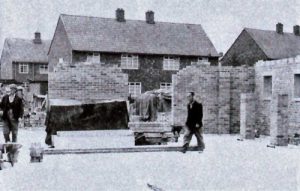
The current church site was purchased from Newcastle Corporation in early 1956 for £480 and building tenders invited in January 1957. The cost of building plus all fees and charges was £16450 (!). This sum was found from generous grants, donations and an interest-free loan. A contract with a local builder was signed on the 5th of February 1957 and building commenced in March 1957.
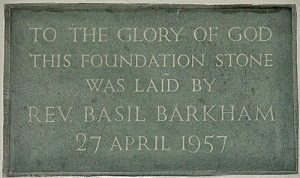
The foundation stone was laid on Saturday the 27th of April 1957 by Rev. Basil Barkham in the presence of the Moderator of the General Assembly and approximately 250 others.
On completion the opening ceremony was conducted on Saturday the 2nd of November 1957 by Rev. Alfred Webb and dedicated by the Moderator of the General Assembly. In addition the ceremony was supported by 130 clergy and lay people of other Presbyterian churches as well as 250 members, adherents and friends of St. Andrew’s.
The first Sunday services were held on the 3rd of November 1957. There was only one (evening) service until the first minister (Rev. Gordon Harris) was appointed in April 1958.
The regular congregation numbered 80.
FURNISHINGS & EQUIPMENT
Although the (large!) sum of £960 was initially spent in providing essential and desirable furniture, carpeting, hymn-books, communion and other equipment, many generous donations of items and money to purchase them have been made in the last 50+ years.
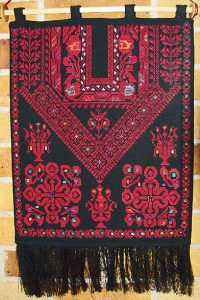 The Revd. David Jenkins, while Moderator of Northern Province 1987-99, was a member of St. Andrew’s and in 1991 attended the World Council of Churches in Canberra. He returned with the tapestry shown here, embroidered by an Anglican parish in Tasmania.
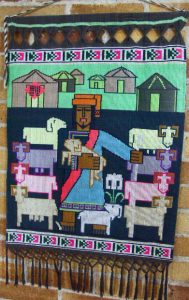
In 1998 David was Moderator of General Assembly and on return from a trip to China presented the ‘Good Shepherd’ tapestry.
The Revd. Dale Rominger was minister at St.Andrew’s from 1991-96 whilst his wife, Roberta, was Minister at a neighbouring URC. They visited the Holy Land in 1995 and returned with an embroidery (not shown here) from the Women’s Child Care Society in Beit Jalor. (Dale later became the URC’s ‘ambassador’ for International Relations and Roberta is now the General Secretary of the URC).
MANSE & HALL
The Manse is a large detached house adjacent to the church and was completed in 1958 at a cost of £5190. The Church Hall was built in 1964 at a cost of £5650. Both are maintained in excellent condition and are available for use to this day.
PUBLIC WORSHIP
From 1958 Sunday services were held at 11.15am. This was changed in 1974 to the current time 10.45. Evening services were discontinued in the 1990s. A printed Order of Service is provided for every worshipper.
All the main church festivals are held – Easter, Pentecost, Christmas, Harvest, Remembrance etc. Holy Communion is quarterly. On Maundy Thursday preceding Good Friday a ‘Tenebrae’ or ‘Gathering Darkness’ service is held. It is a popular service of great meaning.
St. Andrew’s has always had a good number of lay members able to lead worship. A worship group also occasionally leads our devotions. It is a sad reflection of our times that we no longer have any youth or Junior Church worship, but a welcoming provision is always made for any child or young person visiting the church with parents, grandparents, family.
MUSIC
The music is provided by our regular organist but we are fortunate in having other musicians available to help out on the rare occasions she is not able to attend.
The organ is a pipe organ built by R H Walker & Son and maintained by Harrison & Harrison, Durham. There is also an excellent Yamaha digital piano. Members are able to add other instruments (flute, Northumbrian pipes, etc.) on various occasions.
The original hymnbook was The Church Hymnary (published for the Church of Scotland and other Presbyterian churches). This was followed by the 3rd edition of Church Hymnary (CH3) along with Congregational Praise to accommodate the joining of Presbyterians and Congregationalists to form the United Reformed Church. In the 1980s Mission Praise was added. In 1991 we adopted the URC hymnbook ‘Rejoice & Sing’. Revd. David Jenkins, then a member of our congregation, was much involved in the compilation and editorial of Rejoice and Sing and later wrote useful guides to effective use of the book. Rejoice & Sing remains in use today.
ECUMENICAL
St. Andrew’s has always enjoyed good relations with other nearby churches – particularly the Anglican Church of the Ascension, St. Cuthbert’s Roman Catholic Church and our closest neighbour, the Jewish Reformed Synagogue.
OUR LEGACY
Our recent minister, James Breslin, summed up our philosophy:-
‘Reformed churches, at their best, do not seek to copy the practices and actions of their forefathers, but rather seek to address the questions their forefathers addressed and provide answers for today, and not for yesterday. St. Andrew’s has done that, changing in many ways as it seeks to relate to the changing community in which it is set.’

About the United Reformed Church
The best summary of the history and development and nature of the United Reformed Church is that which follows. It was written by Rev. Stephen Orchard (former Moderator of the General Assembly)
Across England, Scotland and Wales, the United Reformed Church has nearly 90,000 members and regular worshippers, in 1500 local congregations.
The United Reformed Church shares the Trinitarian tradition and creeds of all the major Christian denominations. The Bible is taken to be the supreme authority for the Church, together with certain historic statements of the United Reformed Church.
Respect for individual belief and a conviction that majorities are not always right mean that the Church is not dogmatic and embraces a wide variety of opinions.
The United Reformed Church takes the name ‘Reformed’ because it has its roots in the Reformation of the 17th Century, but also because it seeks to be continually reforming, to equip itself to be a Church for today. It is part of the worldwide family of Reformed Churches, which has a total membership of around 70 million people.
It has a strong commitment to church union and the ecumenical movement. Its local churches are often partnerships with other denominations, and in some parts of England, local United Reformed and Methodist churches work together in what is termed a United Area.
History
The United Reformed Church was first formed in 1972 by a union of the Presbyterian Church of England and the majority of churches in the Congregational Church in England and Wales. It was joined later by the Re-formed Association of the Churches of Christ in 1981 and the Congregational Union of Scotland in 2000.
The oldest churches have a history going back to the 17th century and the Reformation. Other congregations were formed during the Evangelical Revival in the eighteenth century or by denominational expansion in the nineteenth and early twentieth century.
Churches were opened in new housing areas in the late twentieth century, but many of these were joint ventures with the Church of England, the Methodist Church and the Baptist Union.
Structure
The Church sets a high value on individual conscience and the ability of its members to reach common understanding. Local congregations hold meetings to govern their affairs, with a group of elected elders having day-to-day responsibility.
There are thirteen synods: the national synods of Scotland and Wales and eleven regional synods for England, in which all local churches are represented.
A General Assembly, representative of members, meets bi-annually (annually until 2008) and makes policy decisions after consultation and debate. All these meetings are held in the belief that the Holy Spirit guides members of the Church in their decision-making.
The formal leadership of the General Assembly is provided by two moderators who serve together for two years, in an honorary capacity. They are elected by members of the Assembly. One moderator is a lay person and the other a minister.
A permanent staff, led by the General Secretary, services the Assembly and its committees. The thirteen synods have their own synod moderators and staff to support the work of local churches. These are usually grouped together under the pastoral care of a paid minister, a man or woman, although the Church also ordains unpaid ministers.
All churches contribute to a central fund from which ministers are paid a stipend to cover their living costs.
You can learn more on the official website of the United Reformed Church: https://urc.org.uk

